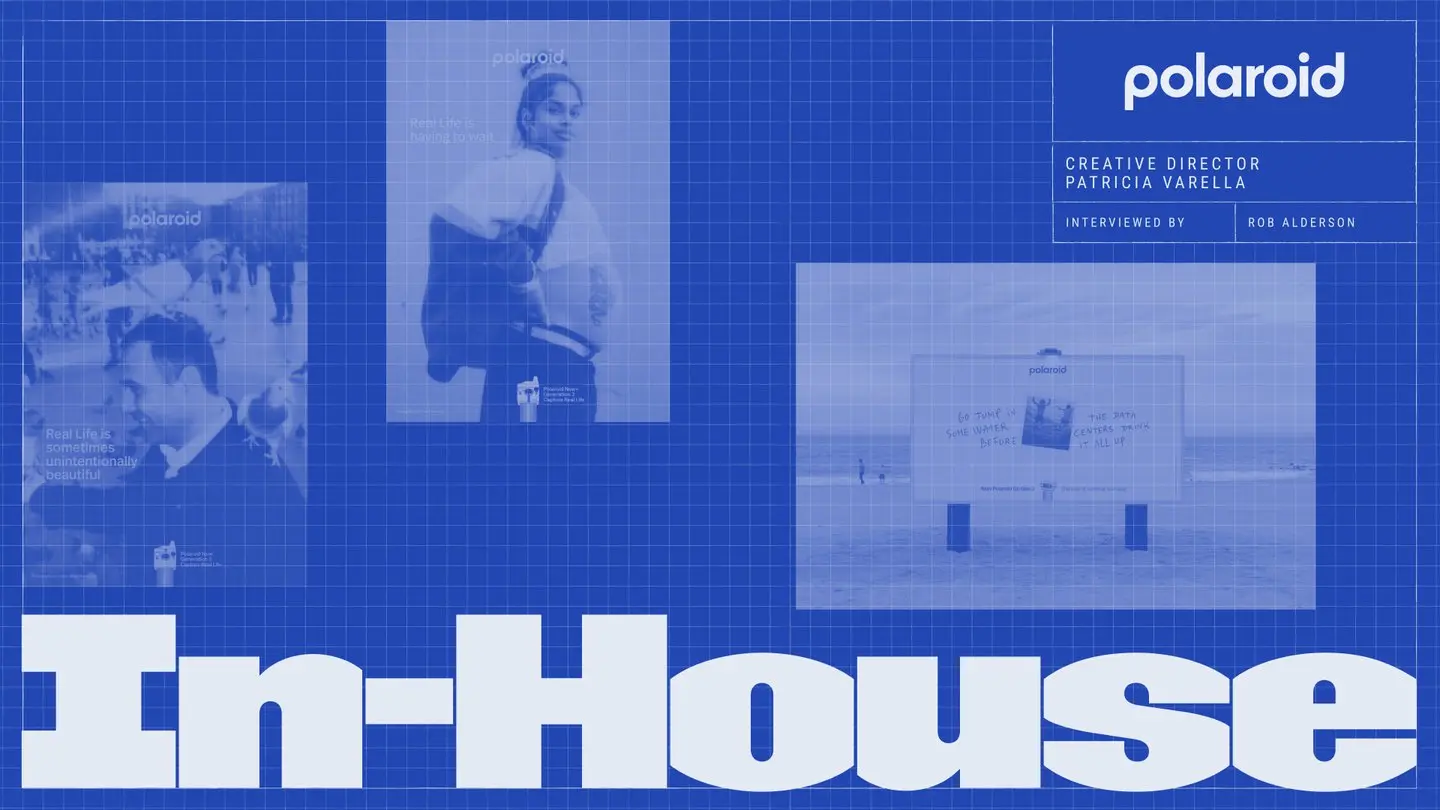
The image is a strip of instant film, slightly warped at the edges, the chemical bloom still visible where the emulsion never fully settled flat. Patricia Varella keeps one taped above her desk. She is Polaroid's creative director now, not an agency contractor brought in for a single campaign cycle, and that distinction is the whole story here.
Polaroid moved its creative leadership in-house at a moment when the entire photography category is being asked to explain its relationship to generative image tools. Varella describes a campaign built specifically to swim against that tide, a bet that imperfection and chemical unpredictability are the brand's actual product, not a nostalgia wrapper around it. This is a hardware company deciding its marketing function belongs inside the building rather than at an outside shop, at the exact moment the category needs a consistent, fast-turnaround position on artificial intelligence rather than a quarterly campaign brief.
The move sits inside a broader pattern across legacy consumer brands: category drift from product manufacturer into media company, with the creative function relocating from agency retainer to internal headcount. Aesop, Liquid Death, and a handful of direct-to-consumer labels made the same relocation years ago, but they did it to control tone at speed on social platforms. Polaroid is doing it to defend a specific, narrow claim: that the physical unpredictability of instant film is not a flaw AI can smooth over, but the entire value proposition.
That claim only works if the person making it understands the chemistry, not just the brand voice. An agency team rotates in and out of an account. An in-house creative director lives with the product's failure modes long enough to argue they are features. Varella's position gives Polaroid a spokesperson who can make that argument from inside the darkroom rather than from a deck.
The Aesop and Liquid Death comparisons are instructive precisely because they do not fully apply. Those brands moved creative in-house to control tone across fast-moving social platforms, a speed argument. Polaroid's speed argument is narrower and stranger: the brand needs someone empowered to say no to AI integration every time a product team or retail partner asks for it, on short notice, without waiting for an agency to churn through a new brief. That is a defensive function as much as a creative one, and defensive functions tend to move in-house before offensive ones do.
There is also a quieter risk embedded in Varella's position. Arguing that chemical unpredictability is the whole product, not a nostalgia wrapper around it, forecloses certain future moves. If Polaroid ever wants to offer an AI-assisted feature, a restoration tool, a colorization option, anything adjacent to the technology it is now defining itself against, the in-house creative director who built the anti-AI campaign becomes the same person who has to explain the reversal. Owning the position from the darkroom rather than the deck means owning the cost of changing it too.
The anti-AI framing is also a bet on where the culture is heading, not where it already is. Most consumer photography marketing in 2026 still treats AI tools as a feature to be integrated, a shortcut to be offered. Polaroid is positioning the absence of that shortcut as the differentiator, months before the wider conversation about synthetic imagery fatigue has fully caught up to hardware brands.
Polaroid now belongs to a small category of manufacturers treating imperfection as an in-house editorial position rather than an outsourced marketing angle.